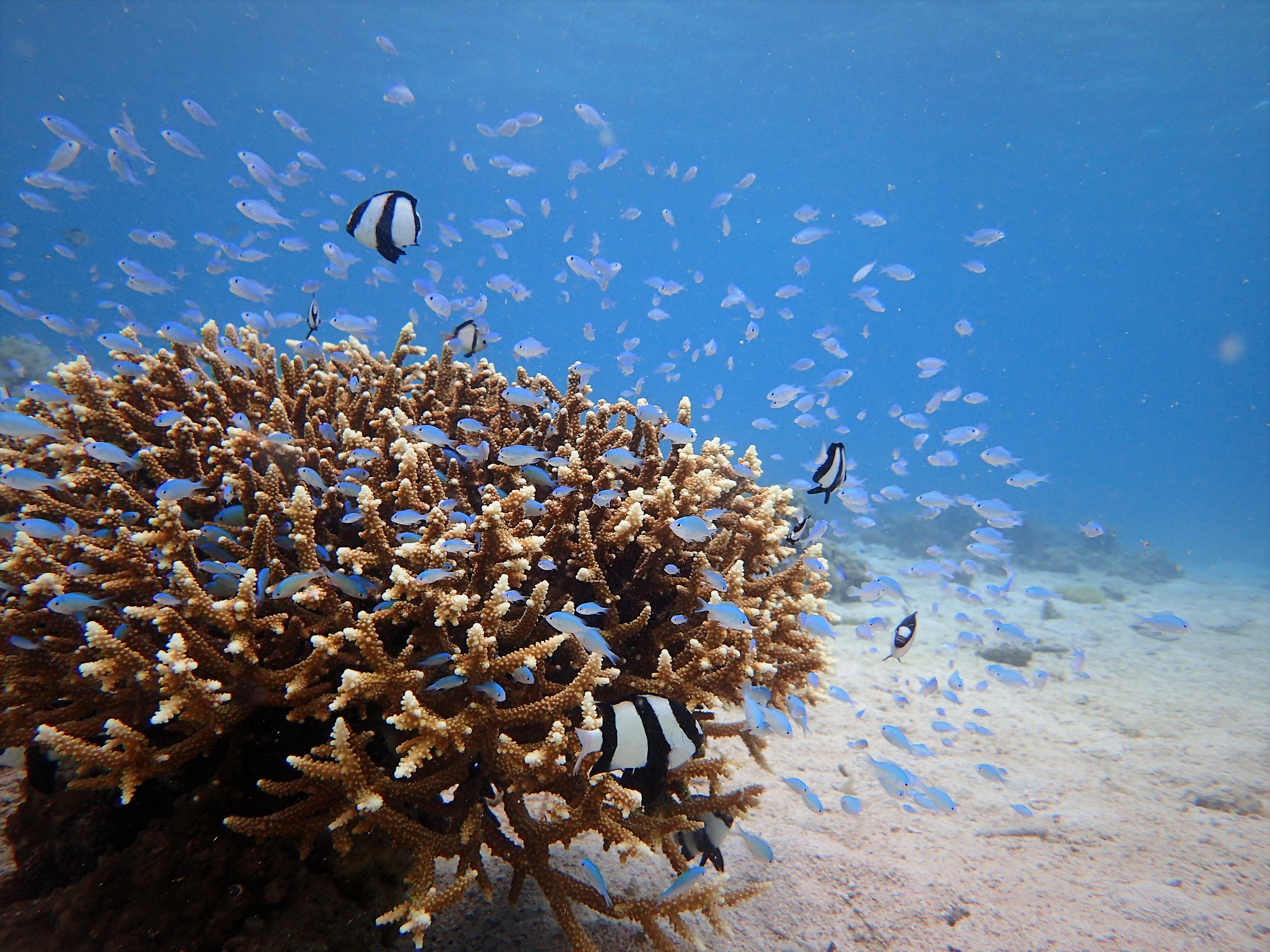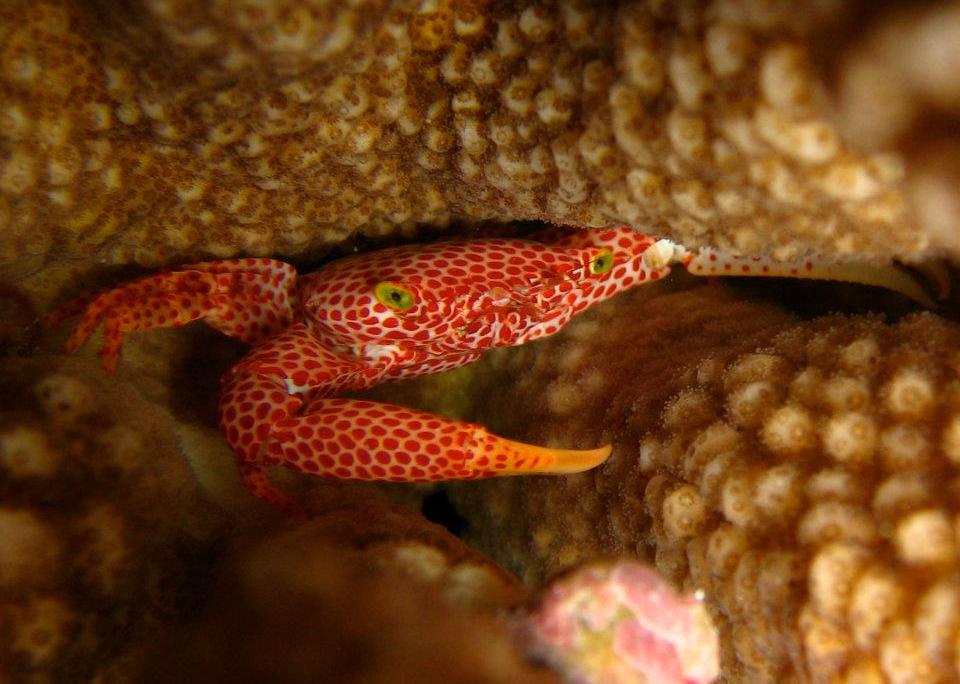
Researchers studied how multiple species of crabs and shrimp living on coral reefs work together to keep their coral homes clean by removing harmful sediment, finding that more species of cleaners leads to cleaner corals. Researchers surveyed coral colonies in French Polynesia to see which crabs and shrimp live together, then conducted controlled experiments adding different combinations of two species (Trapezia crabs and Alpheus shrimp) to corals and measuring how much sediment they removed overnight. Corals alone removed only 10% of sediment, but removal increased to 30% with two symbionts and 48% with four symbionts. The two main species (Trapezia crabs and Alpheus shrimp) co-occurred more often than expected by chance in natural colonies. Each symbiont's per-capita cleaning effect remained the same regardless of how many others were present; they worked independently. All common symbionts only occurred as pairs in nature, never at higher abundances, suggesting intraspecific competition limits density. As coastal development and storms increase sediment loads on coral reefs, understanding how coral cleaners work could inform conservation strategies. The research shows that coral health depends not just on having symbionts, but on maintaining diverse communities of different cleaning species.
Citation
Stier, Adrian C.; Gil, Michael A.; McKeon, C. Seabird; Lemer, Sarah; Leray, Matthieu; Mills, Suzanne C.; Osenberg, Craig W. (2012). Housekeeping Mutualisms: Do More Symbionts Facilitate Host Performance?. PLoS ONE.
This paper is Open Access.
Cite this article
Stier et al. (2012). Multiple Coral-Dwelling Cleaners Improve Sediment Removal. Ocean Recoveries Lab. https://doi.org/10.1371/journal.pone.0032079