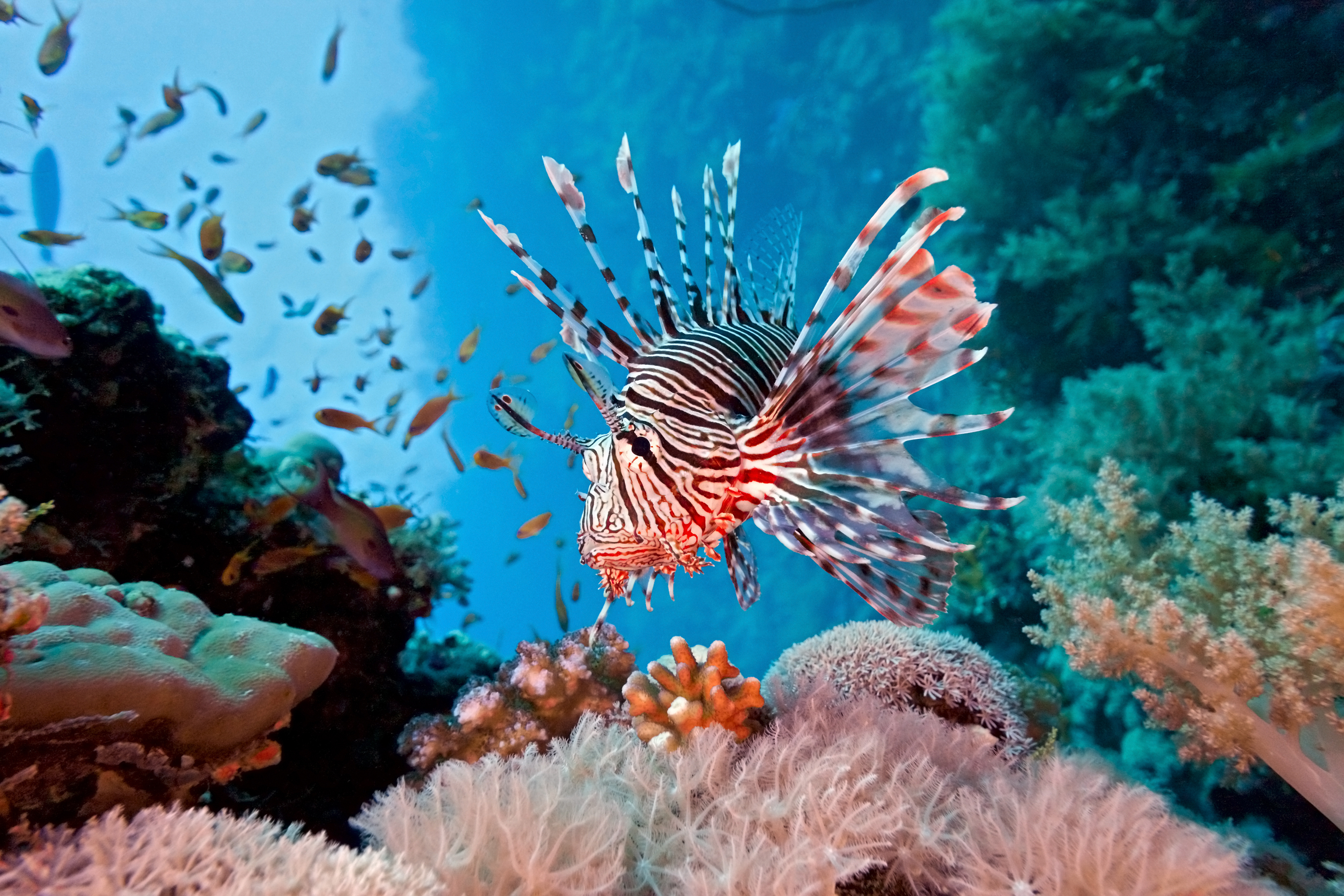
Scientists studying lionfish invasion in Caribbean Panama found that native fish predators are more abundant than the invasive lionfish, and that lionfish don't have worse impacts on prey fish than native predators do. The researchers conducted underwater surveys counting fish on 24 patch reefs and timed swimming surveys in Panama, then ran laboratory experiments comparing how lionfish versus native graysby fish affected survival of masked gobies. They also analyzed citizen science data from across the Caribbean. Native mesopredators were much more common on patch reefs than lionfish and were 30-40 times more abundant during timed surveys. Lionfish and native graysby had similar impacts on masked goby survival and size selection in laboratory experiments. Analysis of citizen science data across eight Caribbean regions showed graysby were more abundant than lionfish. The impacts of this invasive species may be less severe than expected due to low abundance relative to native predators. The research suggests that lionfish management efforts may be succeeding in some regions, and that conservation strategies should consider local ecological context rather than assuming all invasive species have uniformly severe impacts. It supports more specific approaches to invasive species management that account for regional differences.
Citation
Samhouri, Jameal F.; Stier, Adrian C. (2021). Ecological impacts of an invasive mesopredator do not differ from those of a native mesopredator: lionfish in Caribbean Panama. Coral Reefs.
This paper is Open Access.
Cite this article
Samhouri et al. (2021). Native Predators Outnumber Invasive Lionfish in Caribbean Panama Waters. Ocean Recoveries Lab. https://doi.org/10.1007/s00338-021-02132-8