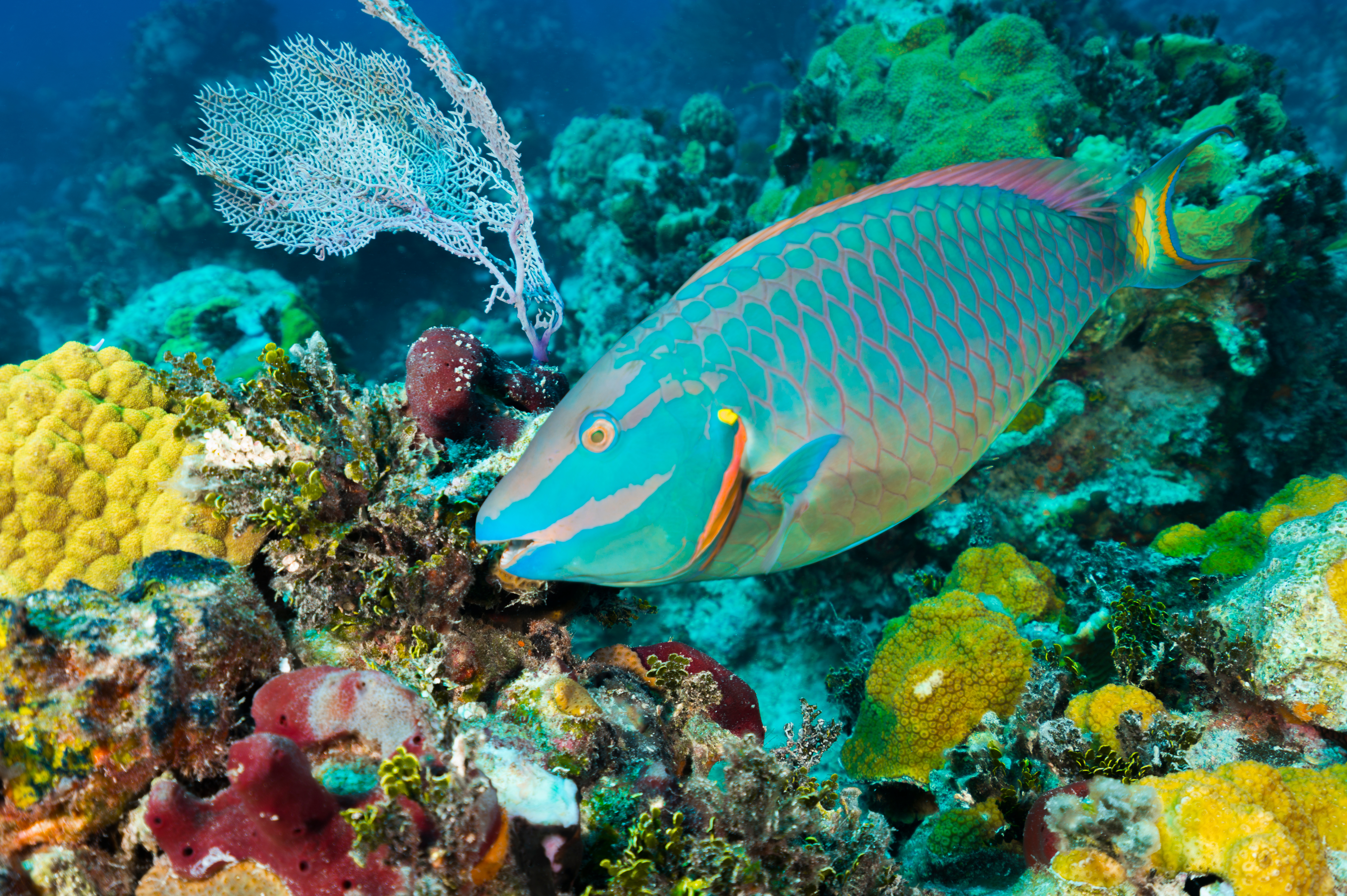
Researchers studied how parrotfish grazing behavior varies across different Caribbean reef sites, finding that the same fish species feed at substantially different rates depending on where they live, which could affect how well reefs recover from damage. The team followed individual parrotfish underwater for 2-minute periods across 13 reef sites in Bonaire, Antigua, and Barbuda, recording how often they bit, how long they spent feeding, and how intensively they grazed, while also measuring reef characteristics like coral cover and fish populations. The same parrotfish species showed significant differences in feeding rates, time spent grazing, and grazing intensity across different reef sites. These behavioral variations could alter the ecological impact of parrotfish populations even when biomass remains constant. Current management approaches that assume consistent grazing behavior across reef systems may be inadequate. The findings suggest that herbivore biomass alone may be an incomplete metric for predicting reef health outcomes. The research challenges current reef management strategies that set herbivore biomass targets assuming fish behavior is consistent everywhere. If parrotfish graze less intensively on degraded reefs, managers may need higher fish populations to achieve the same algae control, and simple biomass targets may fail to protect coral reefs effectively.
Citation
Wilson, Margaret W.; Gaines, Steven D.; Stier, Adrian C.; Halpern, Benjamin S. (2021). Variation in herbivore grazing behavior across Caribbean reef sites. Marine Biology.
This paper is Open Access.
Cite this article
Wilson et al. (2021). Parrotfish Grazing Varies Across Caribbean Reefs. Ocean Recoveries Lab. https://doi.org/10.1007/s00227-021-03844-9