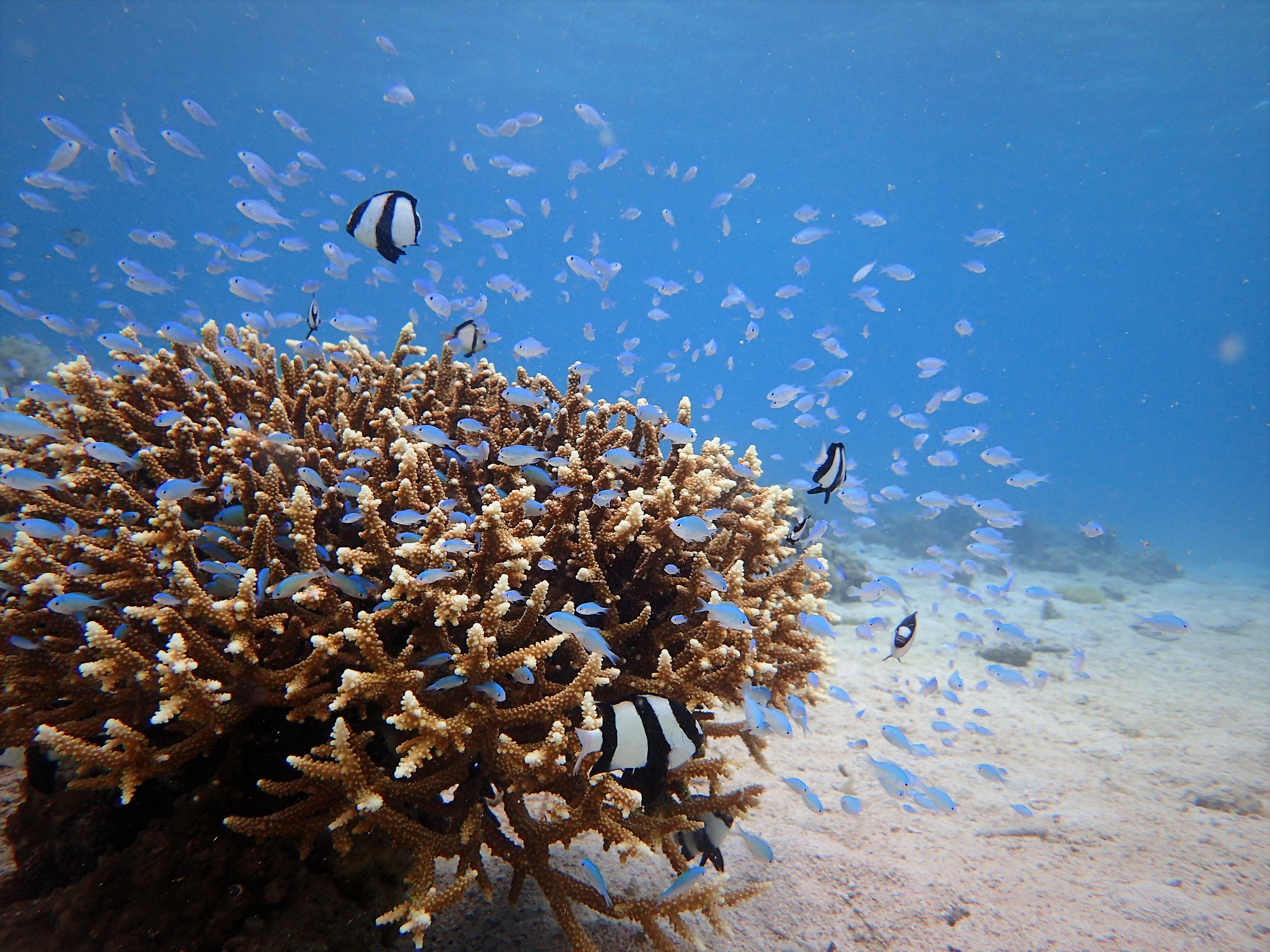
Researchers tested whether adding new coral reef habitat attracts more fish larvae overall (like a 'field of dreams') or simply redirects them away from existing sites. They found evidence for both effects occurring simultaneously. Researchers placed artificial coral reefs in pairs on sandy areas in Moorea, French Polynesia, with some pairs isolated and others surrounded by additional coral colonies. They monitored fish settlement daily for 28 days, removing settlers each day to focus purely on colonization patterns. Isolated reefs received 2-4 times more fish settlers than reefs with neighbors, proving larvae were redirected away from sites with more habitat nearby. Total settlement across all reefs increased only 1.3-fold despite a 6-fold increase in reef area, showing redirection was stronger than new recruitment. Mathematical modeling predicted that habitat addition increases fish populations primarily by reducing competition at existing sites rather than attracting new colonists. Four fish species showed consistent redirection patterns, representing 88% of all settlers observed during the study. The research challenges the common assumption that restoring habitat automatically increases wildlife populations. It suggests that habitat restoration may primarily help existing populations by reducing crowding rather than attracting new individuals, which has major implications for coral reef restoration and marine protected area design.
Citation
Stier, Adrian C.; Osenberg, Craig W. (2010). Propagule redirection: Habitat availability reduces colonization and increases recruitment in reef fishes. Ecology.
Cite this article
Stier et al. (2010). Reef Habitat Addition Can Redirect Fish Larvae Among Patches. Ocean Recoveries Lab. https://doi.org/10.1890/09-1993.1