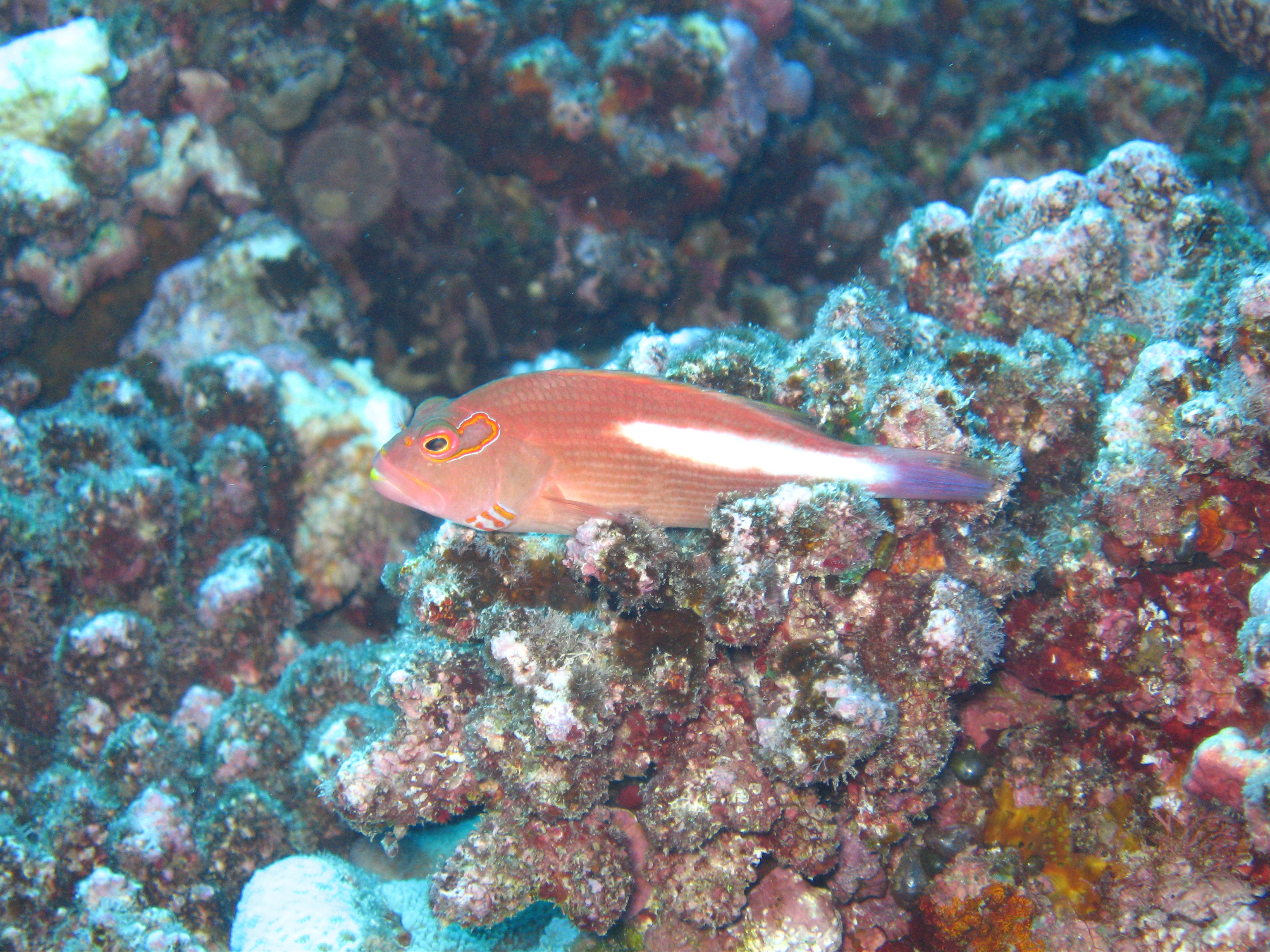
Marine scientists studied whether larger predator fish have stronger effects on their prey than smaller ones of the same species. Surprisingly, they found that small and large hawkfish had similar impacts on prey fish communities in coral reefs. Researchers combined field surveys of coral reefs in French Polynesia with laboratory feeding experiments, comparing how small versus large hawkfish of the same species affected prey fish presence and survival. Small and large hawkfish had similar effects on prey fish; both size classes were equally associated with lower chances of prey fish being present on coral heads. In laboratory experiments, attack rates were indistinguishable between small and large hawkfish feeding on the same prey. The presence of any hawkfish, regardless of size, correlated with reduced prey fish presence compared to coral heads with no hawkfish. Predator size structure alone may not always affect the functional role of small predators in coral reef ecosystems. As human fishing pressure removes large predators from coral reefs, understanding whether smaller predators can compensate is important. This research suggests that even small predators can have significant ecological impacts, meaning their increased abundance might partially offset the loss of larger species.
Citation
Gallagher, Austin J.; Brandl, Simon J.; Stier, Adrian C. (2016). Intraspecific variation in body size does not alter the effects of mesopredators on prey. Royal Society Open Science.
"Surprisingly, they found that small and large hawkfish had similar impacts on prey fish communities in coral reefs."
This paper is Open Access.
Cite this article
Gallagher et al. (2016). Small Coral Reef Predators Can Have Effects Comparable to Larger Predators. Ocean Recoveries Lab. https://doi.org/10.1098/rsos.160414