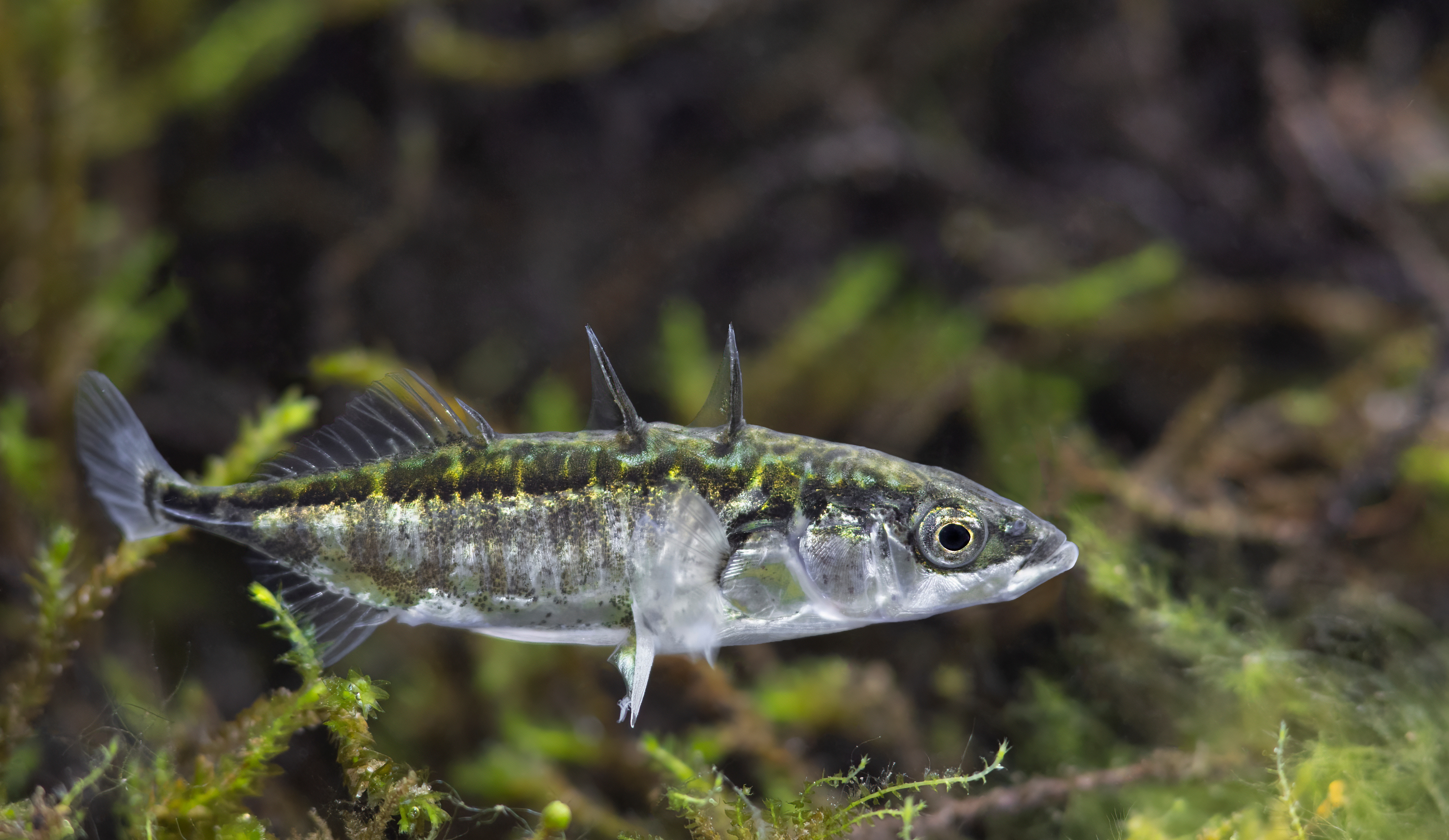
Researchers studied how genetic differences in trees and fish work together to control entire aquatic ecosystems, finding that the productivity of cottonwood trees determines how strongly stickleback fish affect their prey. The researchers planted five genetically different cottonwood trees around aquatic tanks, collected their fallen leaves during autumn senescence, and added different types of stickleback fish to see how tree genetics and fish types combined to affect the whole aquatic community. Cottonwood genetic variation in leaf litter production mediated how strongly stickleback affected their prey; more productive trees led to stronger predation effects. The abundance of four common invertebrate prey species was controlled by the interaction between cottonwood productivity and stickleback morphology. Available phosphorus levels were dictated by the combined effects of tree genetics and fish type. These evolutionary interactions were comparable in strength to simply adding or removing predators entirely. The research shows that rapid evolutionary changes in multiple species can reshape entire ecosystems as powerfully as major ecological disruptions like predator loss, suggesting evolution plays a much larger role in ecosystem function than previously recognized.
Citation
Rudman, Seth M.; Rodriguez-Cabal, Mariano A.; Stier, Adrian; Sato, Takuya; Heavyside, Julian; El-Sabaawi, Rana W.; Crutsinger, Gregory M. (2015). Adaptive genetic variation mediates bottom-up and top-down control in an aquatic ecosystem. Proceedings of the Royal Society B: Biological Sciences.
This paper is Open Access.
Cite this article
Rudman et al. (2015). Tree Genotype Shapes How Fish Affect Aquatic Ecosystems. Ocean Recoveries Lab. https://doi.org/10.1098/rspb.2015.1234