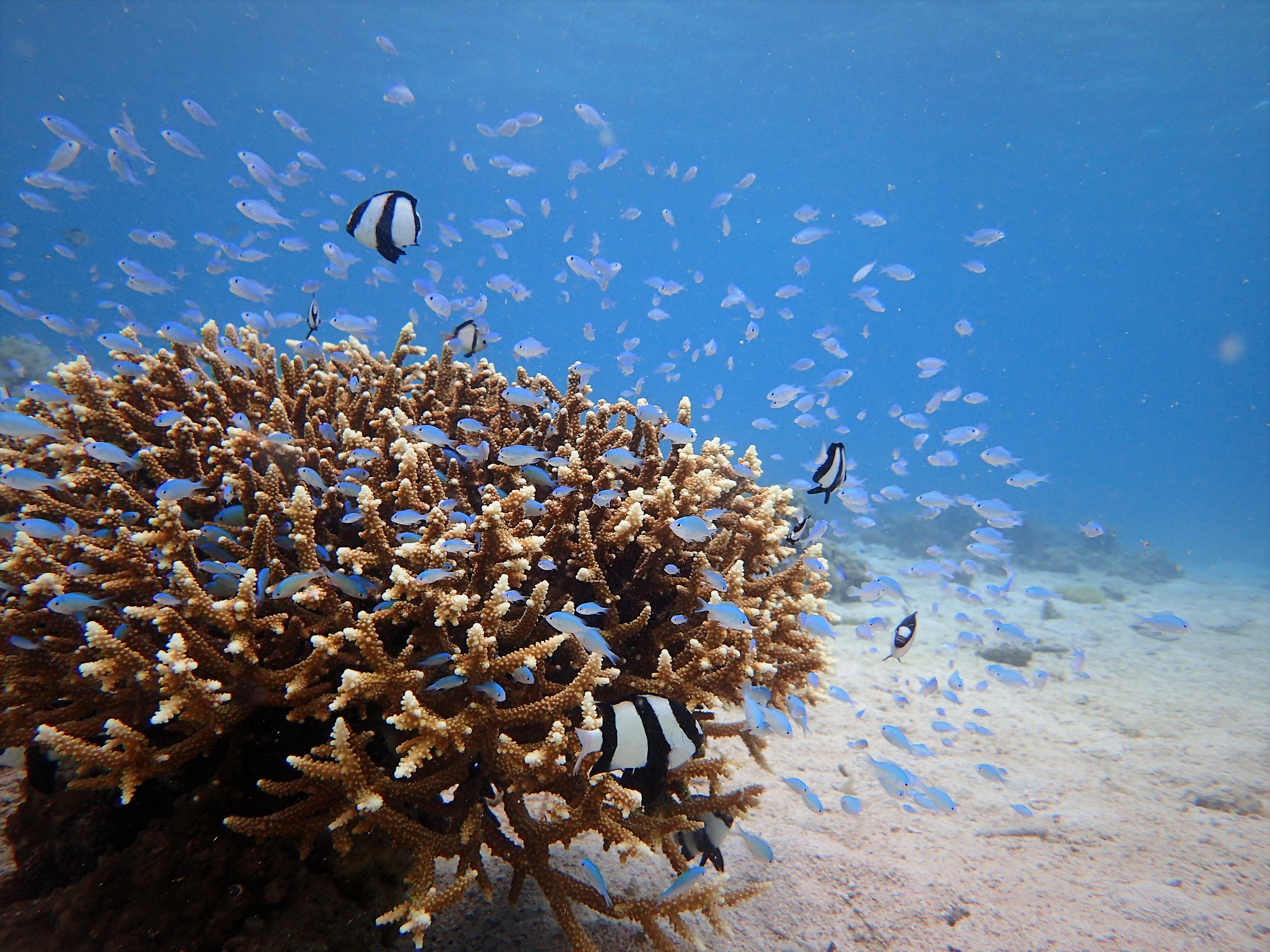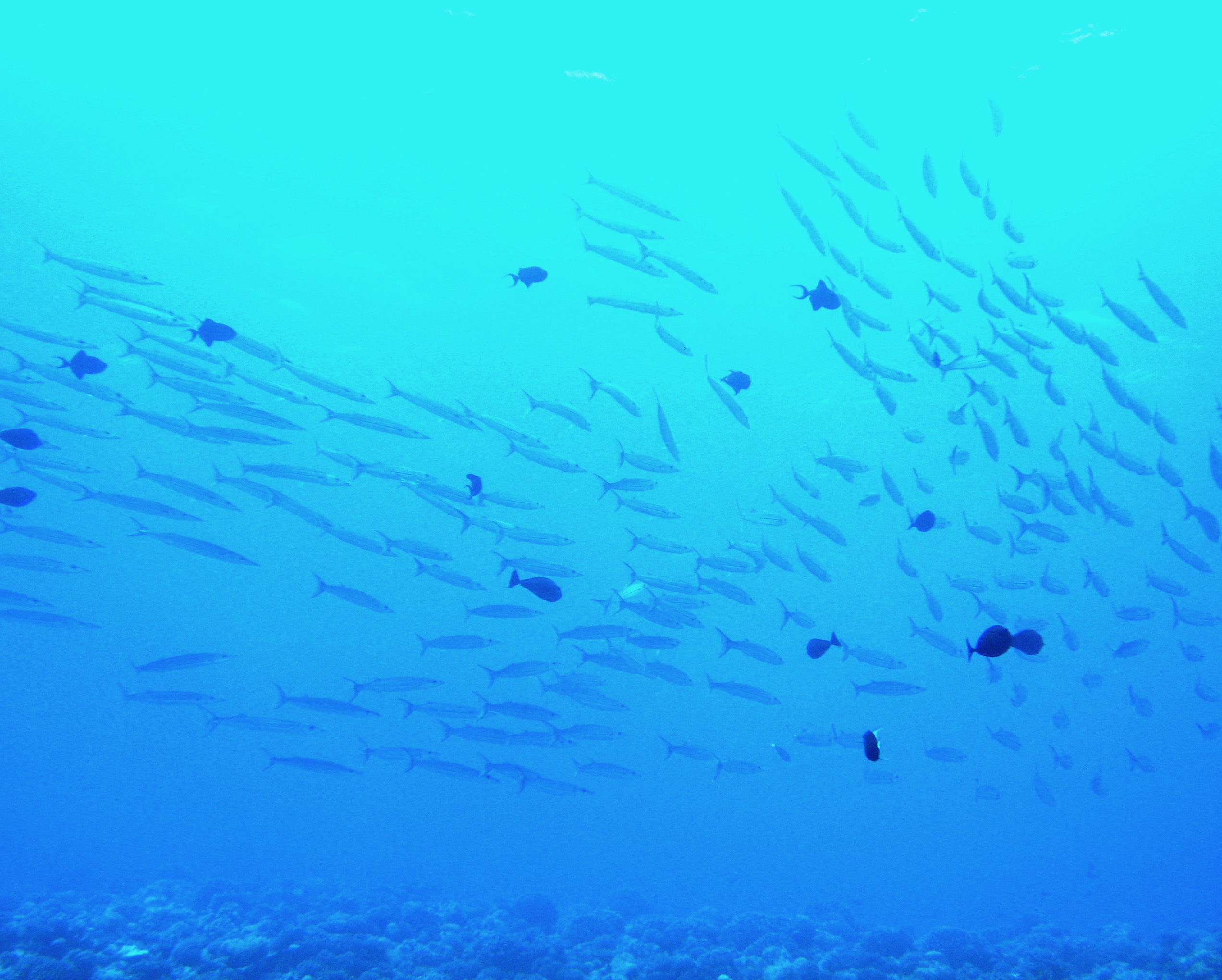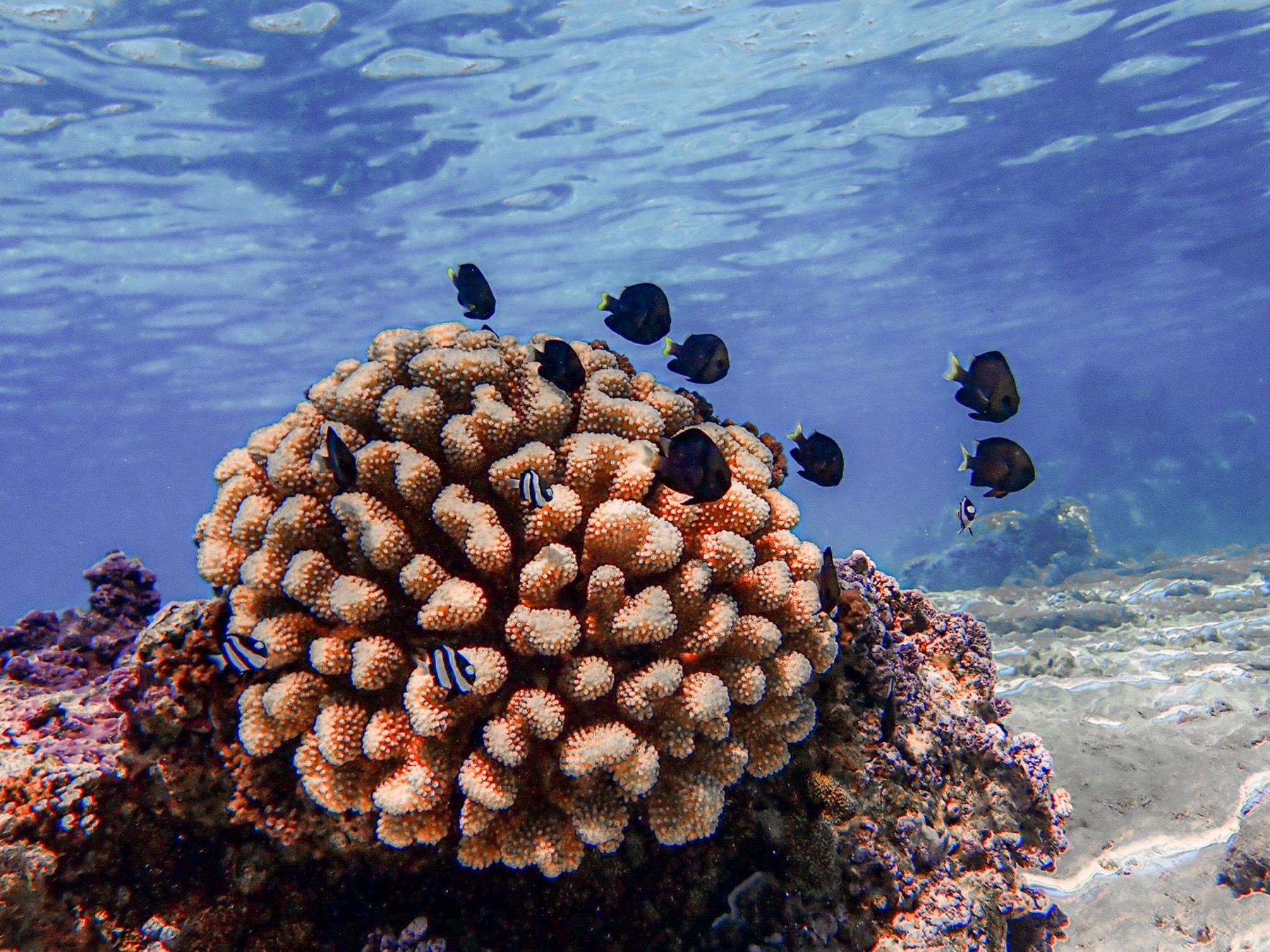
We have come to think of a coral not as a single organism but as a holobiont: a coral animal, its photosynthetic algae, and a broader cast of fishes and invertebrates that live in and around its branches. Much of the recent excitement about these partnerships has focused on how they help corals cope with slow, large-scale stressors like warming and bleaching. But corals also face a more immediate hazard: physical injury from predators, storms, and handling. A wound that fails to close can be overgrown by algae or invaded by pathogens, threatening the whole colony. Whether the fishes living inside a coral help it heal those wounds had gone almost entirely untested. Led by Hayden Vega, and working with Craig Osenberg, Ashley Seifert, Ninah Munk, and me, we set out to find out.
At the Gump Station in Mo'orea, French Polynesia, we ran a controlled experiment on the branching coral Pocillopora, one of the most common reef-builders in the lagoon and a favorite home of the yellowtail damselfish, Dascyllus flavicaudus. We cut 72 coral fragments to a standard size, then gave them either no wound, a small wound, or a large wound. Half the tanks housed a group of damselfish; the other half had none. Every coral received the same food and light. Then, for three weeks, we photographed the wounds and watched them close.
The fish made a striking difference, and the difference grew with the size of the injury. For small wounds, corals living with damselfish healed about 38% faster than corals without them. For large wounds, the effect was even larger: healing rates jumped by 55%, so that wounded corals with fish closed their injuries roughly twice as fast as those without. By the end of the experiment, most of the wounds on corals with fish had fully closed, while most of the wounds on corals without fish were still open. Because our clock stopped at 21 days, we almost certainly underestimated how much the fish helped.
"The fish made a striking difference, and the difference grew with the size of the injury."
Healing was not the only thing that suffered when fish were absent. We also measured photosynthetic efficiency, a gauge of how well the coral's algal symbionts were working. In corals with damselfish, that efficiency stayed high regardless of how badly the coral had been wounded. In corals without fish, it fell steadily as wounds got larger. Turf algae told the same story: colonizing algae took hold on wounds about nine times more often when fish were absent, exactly where a coral can least afford the competition. Interestingly, the fish did not measurably change how much new skeleton the corals laid down. Their benefit was concentrated in tissue repair and symbiont performance.
Why would a resident fish speed a coral's recovery? Several mechanisms likely act together. Damselfish excrete ammonium-rich waste that fertilizes the coral's algae, supplying the extra energy that rebuilding tissue demands. Their constant movement through the branches, especially at night when oxygen runs low and the metabolic cost of healing is high, stirs water and delivers oxygen. And by keeping wounds from being smothered by algae, they buy the coral time to close them. Together, these findings add tissue repair to the growing list of ways coral-associated fishes bolster reef resilience, alongside their known roles in coral growth and heat tolerance. Protecting these everyday partnerships may be as important for reef recovery as protecting the corals themselves.
Citation
Vega, Hayden; Osenberg, Craig W.; Seifert, Ashley W.; Munk, Ninah; Stier, Adrian C. (2026). Coral-associated fishes accelerate coral wound healing and photosynthetic recovery. Biology Letters.
This paper is Open Access.
Cite this article
Vega et al. (2026). Coral's Live-In Fish Are Reef Medics That Speed Wound Healing. Ocean Recoveries Lab. https://doi.org/10.1098/rsbl.2026.0177