We examined competition on coral reefs requires looking beyond which species arrive to consider when they arrive. Research on two wrasse species in French Polynesia reveals how timing of arrival affects competitive outcomes among young reef fish.
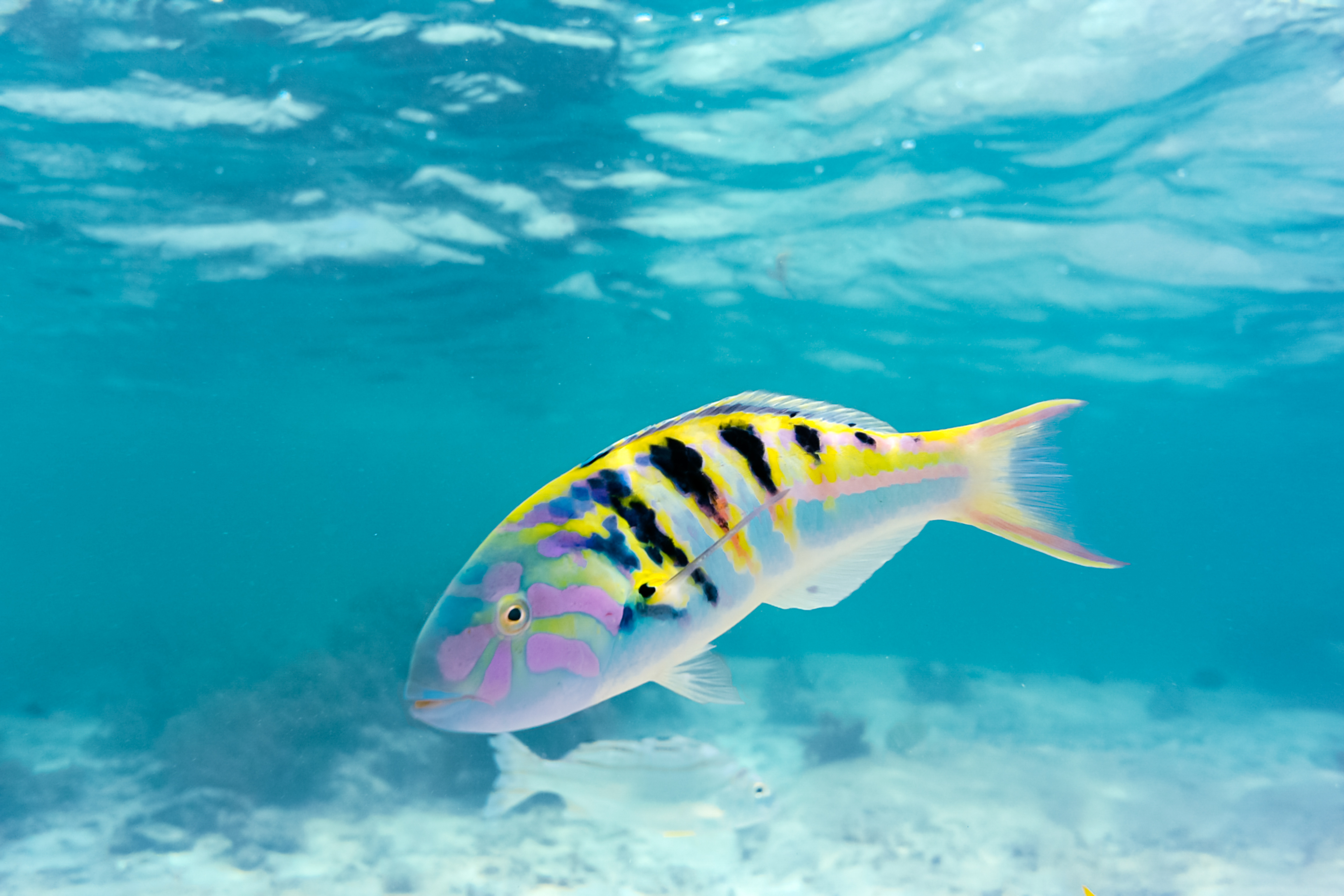
The study examined whether the timing of arrival affects how young reef fish compete with each other. Most coral reef fish spend their early weeks as tiny larvae drifting in the open ocean before settling onto reefs in unpredictable pulses around new moons. We suspected that differences in arrival time might have consequences for survival. To test this, they created experimental reefs and controlled when recent settlers of two wrasse species - Thalassoma hardwicke and T. quinquevittatum - arrived at the reefs.
Our results showed that both species survived best in the absence of competitors, but when competitors were present, they did best when they arrived at the same time. Survival declined as each species entered the community progressively later than its competitor, and this decline coincided with increased aggression from the earlier-arriving fish. The competitive advantage wasn't species-specific - whichever species arrived first dominated, regardless of identity. Even within the same species, earlier-arriving T. hardwicke individuals had similar competitive advantages over their later-arriving conspecifics.
"The lasting consequences of timing during those first critical days on the reef could be key to predicting how these communities will change as ocean conditions shift."
The strength and consistency of these priority effects across both inter- and intraspecific competition was notable. The paper notes that the mechanism behind how early arrivals gain their advantage remains unclear - whether through better territory establishment or other factors. The duration of these advantages as fish grow also remains to be determined.
These findings suggest that coral reef communities aren't just shaped by which species arrive, but when they arrive. In an era of climate change, when ocean currents and spawning patterns are shifting, changes in the timing of larval delivery could reshape reef communities. The research provides empirical evidence for 'competitive lotteries' - the idea that chance events like arrival timing can maintain species diversity by preventing any one species from consistently dominating.
Understanding how these priority effects play out in natural systems, where arrival timing is controlled by unpredictable ocean currents, represents an important area for future research. The lasting consequences of timing during those first critical days on the reef could be key to predicting how these communities will change as ocean conditions shift.
Citation
Geange, Shane W.; Stier, Adrian C. (2009). Order of arrival affects competition in two reef fishes. Ecology.
Cite this article
Geange et al. (2009). First Come, First Served: Reef Fish That Arrive Early Dominate Their Late-Coming Competitors. Ocean Recoveries Lab. https://doi.org/10.1890/08-0630.1