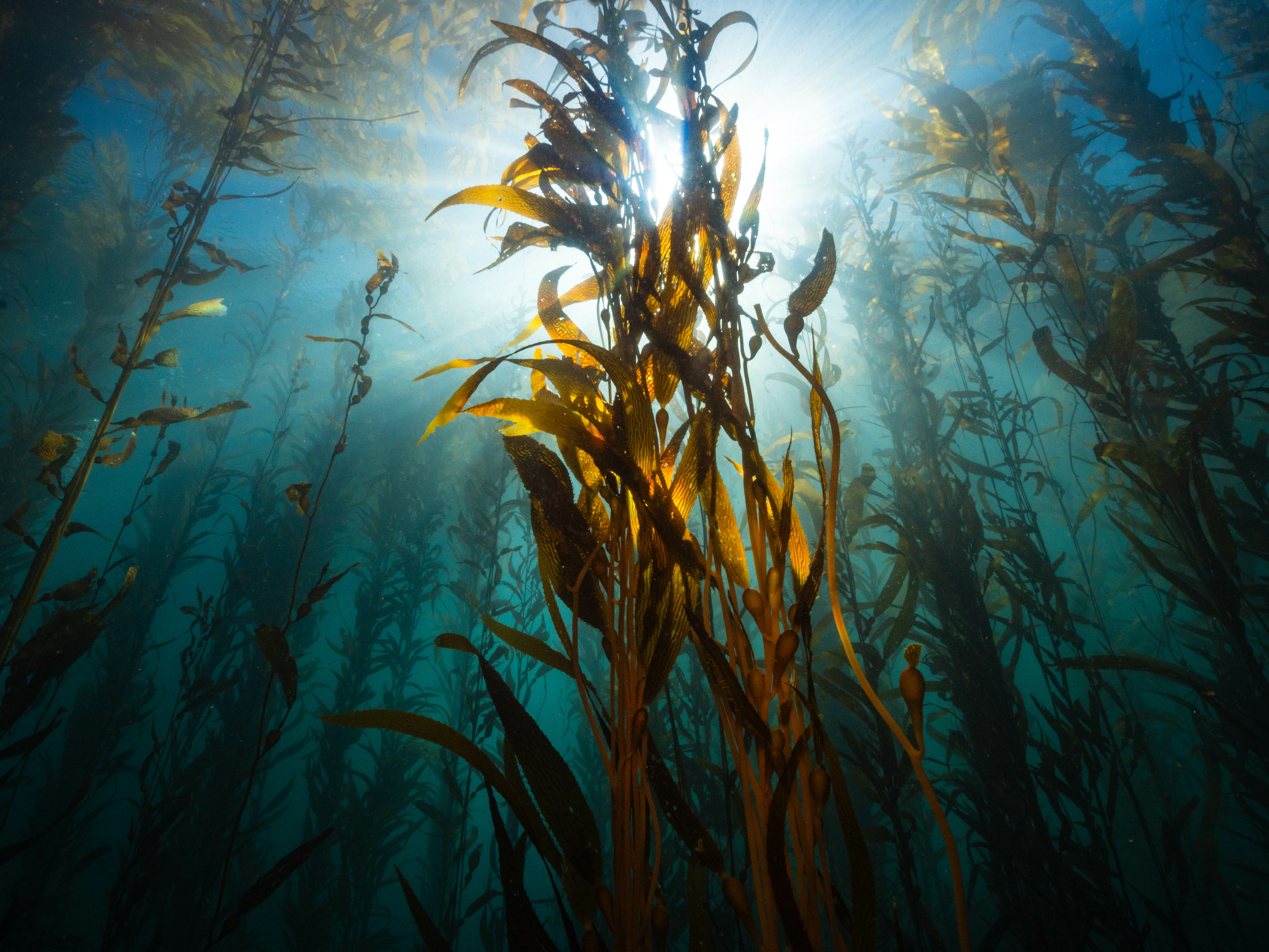
We analyzed 18 years of data from 32 plots across nine rocky reefs in the Santa analyzing 18 years of data from 32 plots across nine rocky reefs in the Santa Barbara Channel discovered how giant kelp functions as an ecosystem stabilizer. The study, led by Thomas Lamy and colleagues Craig Koenigs, Sally Holbrook, Robert Miller, Adrian Stier, and Daniel Reed, sought to answer whether the stability of giant kelp enhances the stability of the diverse community living beneath its canopy.
Every summer from 2001 to 2018, divers recorded the abundances and sizes of 114 different species—53 types of understory algae, 61 sessile invertebrates, and one seagrass species—living on the seafloor beneath the kelp canopy. We converted these measurements to biomass and calculated stability as the inverse of variability over time.
Our results revealed that the stability of understory communities was positively and indirectly related to giant kelp stability, primarily through kelp's direct positive association with species richness. More stable kelp supported more species, and more species resulted in more stable communities overall. Community stability was positively related to species richness through two mechanisms: increased stability of individual species and increased asynchrony between species.
A key finding was that the stabilizing effects of richness were three to four times stronger when algae and invertebrates were considered separately rather than together. This suggests that competition for shared resources, rather than different responses to environmental conditions, was the primary force stabilizing these communities.
Our research has important implications because foundation species like giant kelp face increasing threats worldwide from climate change, pollution, and other human impacts. The study demonstrates that kelp loss affects not just the kelp itself, but the stability of entire underwater ecosystems. The kelp acts as a biodiversity engine, and that biodiversity creates resilience against environmental fluctuations. Our study is among the first to quantify how the temporal stability of a foundation species directly influences the stability of the complex communities it supports.
Citation
Lamy, Thomas; Koenigs, Craig; Holbrook, Sally J.; Miller, Robert J.; Stier, Adrian C.; Reed, Daniel C. (2020). Foundation species promote community stability by increasing diversity in a giant kelp forest. Ecology.
Cite this article
Lamy et al. (2020). Giant Kelp Acts as Ecosystem Stabilizer Through Biodiversity in 18-Year California Study. Ocean Recoveries Lab. https://doi.org/10.1002/ecy.2987