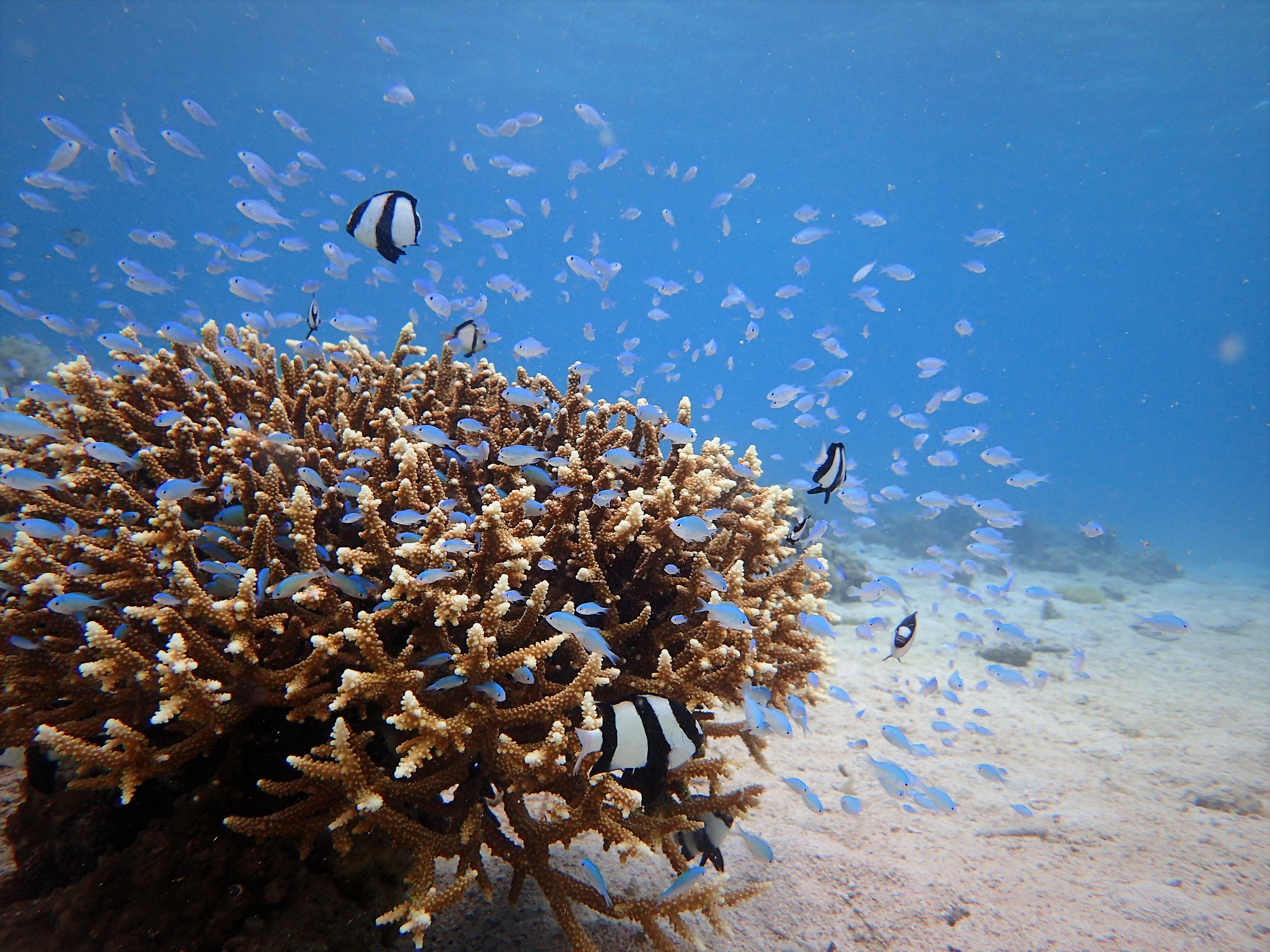
We investigated why some habitat patches consistently harbor more organisms than others, even when they seem identical. Research by Elizabeth Hamman, Scott McKinley, Adrian Stier, and Craig Osenberg shows that the answer lies in geometry: the spatial arrangement of patches creates invisible channels that funnel colonizers toward certain locations. We developed mathematical models to explore how organisms moving through a landscape interact with the configuration of habitat patches. They focused on systems where colonizers arrive from a larger pool, like fish larvae settling onto reef patches or insects colonizing forest fragments. Their key insight is that landscape configuration itself generates spatial heterogeneity in colonization. Consider a cluster of habitat patches: those in certain positions intercept more colonizers simply because of where they sit relative to the flow of arriving organisms. A patch on the edge of a cluster facing the direction colonizers typically arrive will accumulate more settlers than one tucked in the center, regardless of any differences in habitat quality. These patterns prove remarkably persistent. Even after many generations of colonization and mortality, the spatial biases created by landscape geometry remain. This means that certain patches will consistently outperform others in population size, creating what appears to be habitat quality differences but is a consequence of spatial arrangement. The findings have practical implications for conservation in fragmented landscapes. When designing marine reserves or wildlife corridors, the spatial arrangement of protected areas matters beyond just their total size. Strategic placement can use these geometric effects to maximize colonization success. The research also helps explain puzzling patterns in natural systems. Ecologists often observe substantial variation in population density across apparently similar habitats. This variation is typically attributed to unmeasured habitat quality differences. The new models suggest that some of this variation may simply reflect the landscape's geometry, an insight that could improve population models and management strategies.
Citation
Hamman, Elizabeth A.; McKinley, Scott A.; Stier, Adrian C.; Osenberg, Craig W. (2018). Landscape configuration drives persistent spatial patterns of occupant distributions. Theoretical Ecology.
"Ecologists often observe substantial variation in population density across apparently similar habitats."
Cite this article
Hamman et al. (2018). Habitat Arrangement Can Create Persistent Spatial Patterns. Ocean Recoveries Lab. https://doi.org/10.1007/s12080-017-0352-1