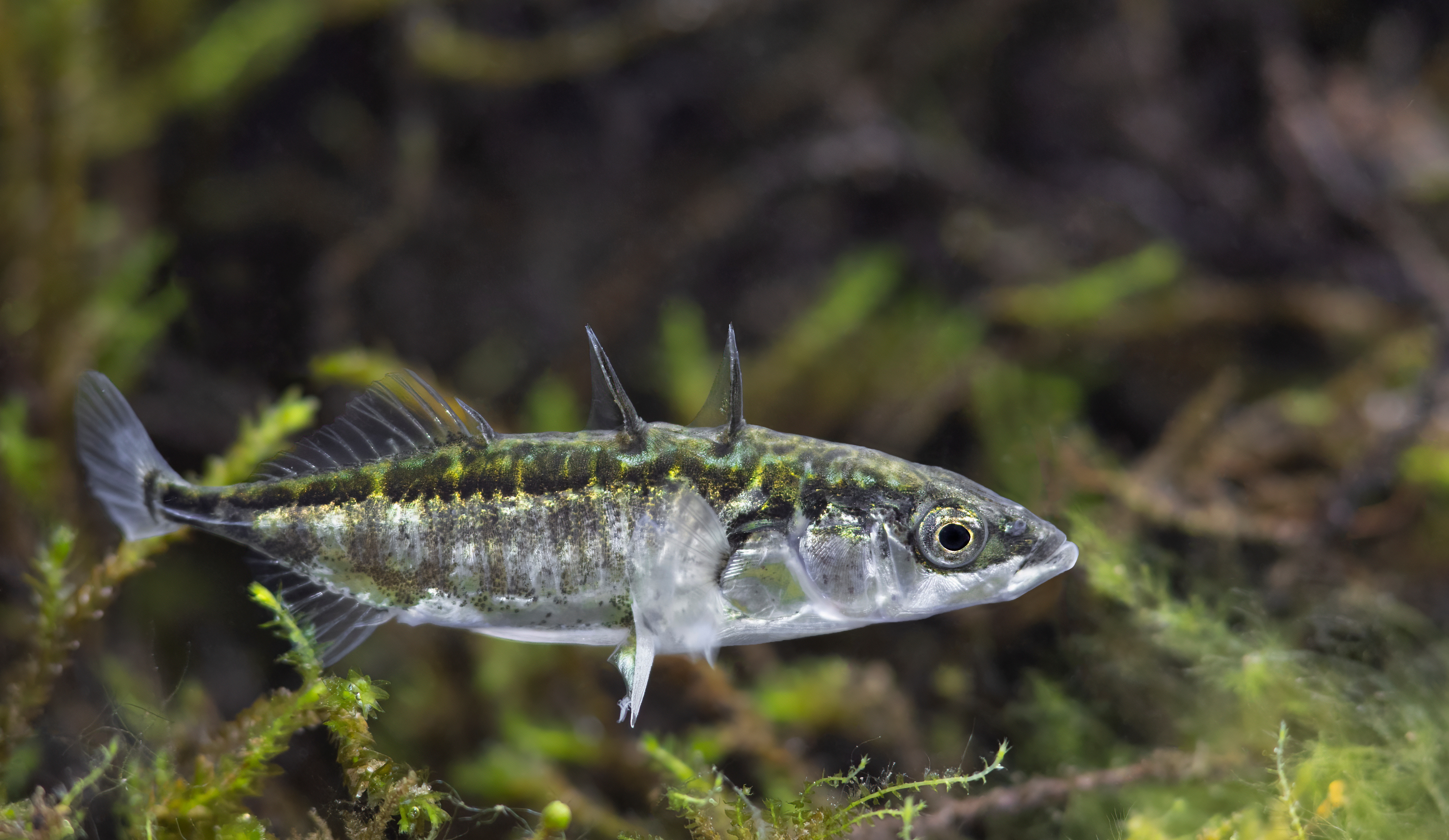
We conducted a large-scale experiment in British Columbia found that genetic makeup of cottonwood trees determines how powerfully stickleback fish control their underwater prey communities. We examined whether genetic differences within species can reshape communities when multiple species with their own genetic variations interact in the same ecosystem.
They planted five genetically distinct cottonwood trees around cattle-tank-sized aquatic mesocosms, collected leaf litter as it senesced in the autumn, and then added either benthic or limnetic stickleback ecotypes. Each cottonwood genotype contributed different amounts of leaf litter to the aquatic environment.
The abundance of four common invertebrate prey species was dictated by the interaction between cottonwood productivity and stickleback morphology. More productive cottonwood genotypes amplified the predation effects of stickleback on their prey. Even phosphorus availability, the most critically limiting nutrient in freshwater systems, responded to these genetic interactions. These evolutionary effects were comparable in strength to the impacts of adding or removing predators entirely.
"Even phosphorus availability, the most critically limiting nutrient in freshwater systems, responded to these genetic interactions."
Our research reveals evolution as an underappreciated driver of ecosystem function. If genetic differences that can evolve rapidly are reshaping communities as powerfully as major ecological disruptions, then conservation strategies need to account for evolutionary potential, not just species presence or absence. The interactive effects documented suggest that protecting genetic diversity within species might be as crucial as protecting species diversity itself.
Our findings demonstrate that intraspecific variation, which can evolve rapidly, is an under-appreciated driver of community structure and ecosystem function, showing that a multi-trophic perspective is essential to understanding the role of evolution in structuring ecological patterns.
Citation
Rudman, Seth M.; Rodriguez-Cabal, Mariano A.; Stier, Adrian; Sato, Takuya; Heavyside, Julian; El-Sabaawi, Rana W.; Crutsinger, Gregory M. (2015). Adaptive genetic variation mediates bottom-up and top-down control in an aquatic ecosystem. Proceedings of the Royal Society B: Biological Sciences.
This paper is Open Access.
Cite this article
Rudman et al. (2015). Tree Genes Control How Fish Shape Entire Aquatic Ecosystems. Ocean Recoveries Lab. https://doi.org/10.1098/rspb.2015.1234