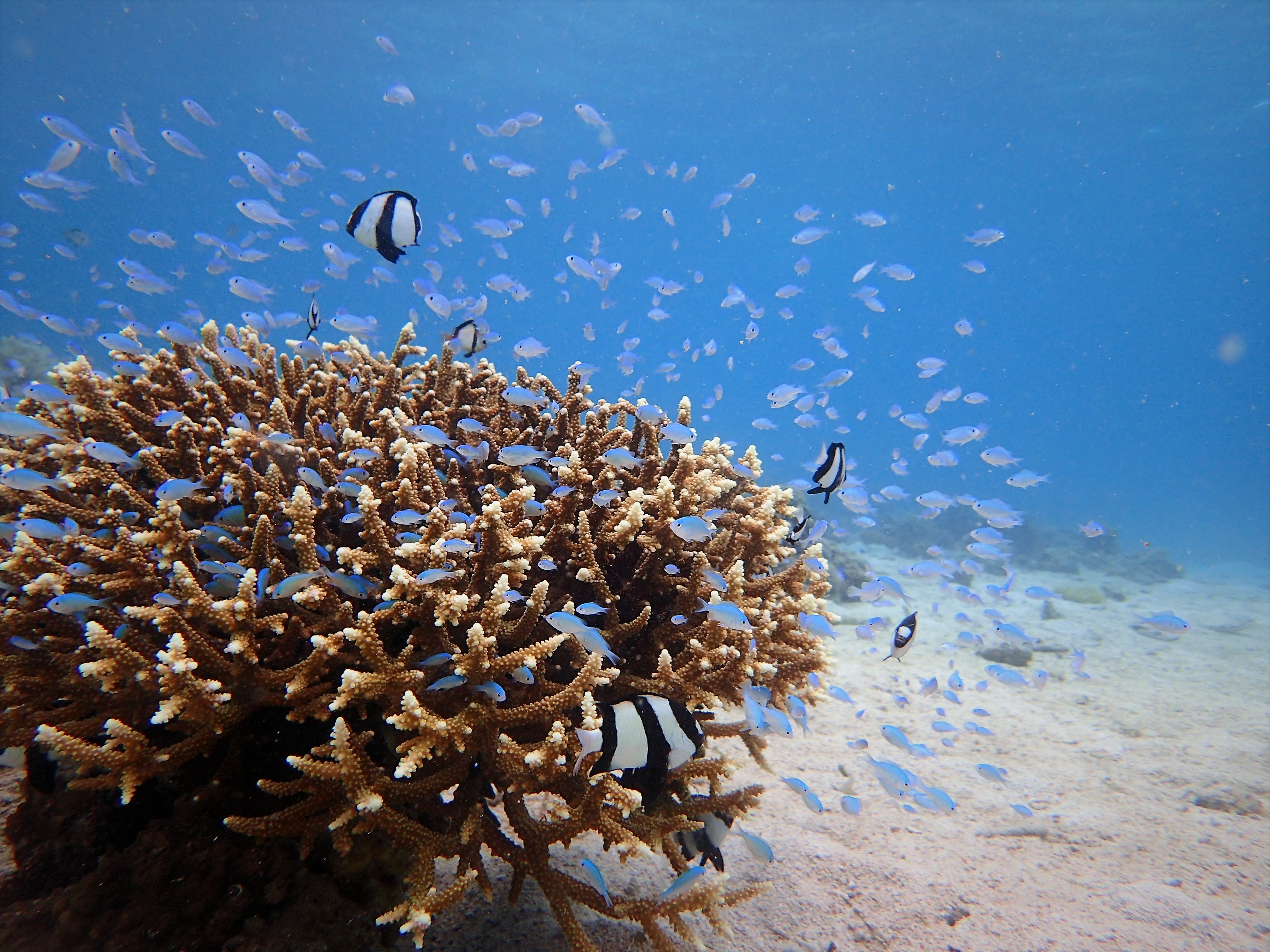
We joined ecologists who have searched for decades for universal rules governing how animal populations grow and stabilize. One of the most fundamental assumptions is density dependence: as populations become crowded, competition and predation should intensify, pushing mortality rates higher and keeping populations in check. But when Craig Osenberg and I synthesized data from 56 studies spanning 38 reef fish species, we discovered something troubling—these rules don't apply consistently.
Our meta-analysis yielded 147 separate estimates of density-dependent mortality, mostly in young fish just settling onto reefs. The variation we found was staggering. Within single species, the strength of density dependence often varied by several orders of magnitude. In some cases, the effect even changed sign—meaning crowding sometimes helped survival rather than harming it. This wasn't random noise; something fundamental was causing these dramatic swings.
Several factors emerged as key drivers of this variation. Predators played an outsized role: when predators were present or abundant, density-dependent mortality intensified considerably. This makes biological sense—crowded groups of young fish may be easier targets or may deplete hiding spots faster. We also found that species traits mattered. Fish that typically arrive on reefs at low densities, or those destined to grow large, experienced stronger density-dependent mortality.
"But when Craig Osenberg and I synthesized data from 56 studies spanning 38 reef fish species, we discovered something troubling—these rules don't apply consistently."
These findings have profound implications for how we manage and conserve marine fish populations. Most fisheries models assume density dependence operates predictably, allowing depleted populations to bounce back as fishing pressure eases. But if density dependence is as variable as our data suggest, recovery trajectories become much harder to predict. A reef with different predator communities, or experiencing different environmental conditions, might see very different population dynamics.
Perhaps most importantly, our results underscore how much context matters. The same species might experience strong density dependence in one location and weak or even reversed effects nearby. Future research needs to move beyond simply detecting density dependence toward understanding the environmental and biological factors that modulate its strength. Only then can we build the predictive models that conservation and management demand.
Citation
Stier, Adrian C.; Osenberg, Craig W. (2025). Widespread Heterogeneity in Density-Dependent Mortality of Nearshore Fishes. Ecology Letters.
Cite this article
Stier et al. (2025). Fish Populations Don't Follow Simple Rules—And That Changes Everything We Thought We Knew. Ocean Recoveries Lab. https://doi.org/10.1111/ele.70262